Giovanni Battista Riccio
Opera Omnia
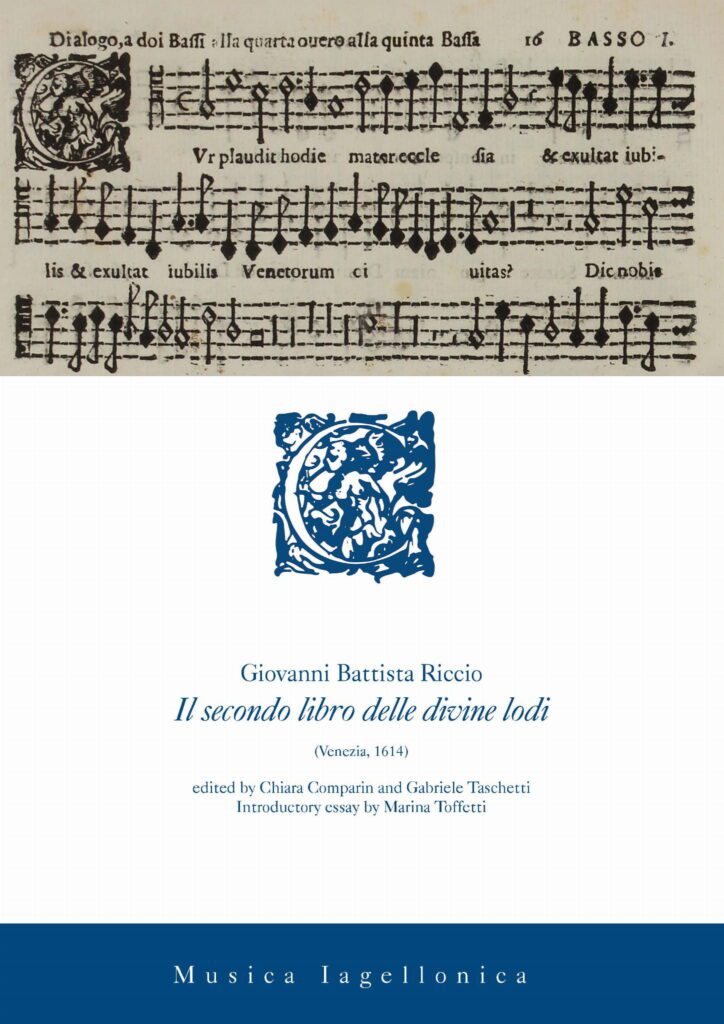
The Secondo libro delle divine lodi includes 28 compositions: 21 vocal (4 for solo voice, 12 for two voices, 2 for three voices, 3 for four voices) and 7 instrumental (5 canzonas for two instruments, plus one sonata and one canzona for four instruments) with basso continuo. 7 compositions have survived in incomplete form.
Giovanni Battista Riccio’s Secondo libro delle divine lodi was published in Venice by Ricciardo Amadino in 1614. The collection is dedicated to Antonio Grimani, bishop of Torcello and patriarch-elect of Aquileia, to whom Riccio would also dedicate the Terzo libro delle divine lodi (1620).
The only known copy of the Secondo libro delle divine lodi survives, preserved in the Biblioteca e Museo Internazionale della Musica in Bologna, has lost one of its five partbooks; as a consequence, seven compositions for three and four voices and basso continuo are missing one vocal or instrumental line, while all the twenty-one compositions for one and two voices and basso continuo are complete. A hypothetical reconstruction of the missing parts of the seven incomplete compositions is provided in the critical edition. An editable digital version of the incomplete pieces, together with transposed versions of the compositions for which transposition indications are given, is also available online.
Downloads
Transposed versions
(Opens PDF in a new tab)
Incomplete compositions
(Directly downloads the linked XML file)
Contents
(Opens PDF’s relevant page in a new tab)
Introductory essay Marina Toffetti: Giovanni Battista Riccio and Il secondo libro delle divine lodi (Venice, 1614): state of the art and research perspectives
Description of the print The texts Editorial criteria Transcription criteria Edition of the texts The musical text Editorial criteria Critical notes
Saggio introduttivo Marina Toffetti: Giovanni Battista Riccio e Il secondo libro delle divine lodi (Venezia, 1614): stato dell’arte e prospettive di ricerca
Descrizione della stampa I testi Criteri di edizione Criteri di trascrizione Edizione dei testi Il testo musicale Criteri di edizione Apparato critico
Edition of the music / Edizione delle musiche 1. Missa sexti toni I. Kyrie II. Gloria III. Credo IV. Sanctus V. Agnus Dei 2. Magnificat 3. Egredimini omnes 4. Exaudi Domine 5. Deus meus respice 6. Domine exaudi 7. Deus canticum novum 8. Benedicam Dominum 9. Iubilate Deo 10. Cur plaudit hodie 11. Attendite popule meus 12. Audi Domine 13. Ave Domine 14. Dilectus meus 15. Hic est panis 16. Ego sum panis vivus 17. Exultat Maria 18. Sonata a 4 19. Canzon a 4 20. Canzon a 2 [I] 21. Canzon a 2 [II] 22. Canzon a 2 [III] 23. Canzon a 2 [IV] 24. Canzon a 2 in echo [V] 25. Peccavi super numerum 26. Vocem iucunditatis 27. Exultavit cor meum 28. Exaudi Domine
Appendix 1 / Appendice 1
Hypotheses of reconstruction of the missing part in the incomplete compositions
Ipotesi di ricostruzione della parte mancante nelle composizioni incomplete Appendix 1. 1. Ave Domine [13] Appendix 1. 2. Dilectus meus [14] Appendix 1. 3. Hic est panis [15] Appendix 1. 4. Ego sum panis vivus [16] Appendix 1. 5. Exultat Maria [17] Appendix 1. 6. Sonata a 4 [18] Appendix 1. 7. Canzon a 4 [19]
Appendix 2 / Appendice 2
Handwritten compositions in the printed copy
Composizioni manoscritte annotate nella stampa Critical notes / Apparato critico Appendix 2. 1. Sanctus Appendix 2. 2. Agnus Dei
About
Website hosted by the University of Padua and curated by Marina Toffetti (scientific director), Chiara Comparin, and Gabriele Taschetti (web designer).